
Expo 2025 Osaka
Design Beyond Things. The Object as an Agent of Transformation
29 August – 13 September 2025
European Pavilion + Baltic Pavilion + Belgian Pavilion, Expo 2025 Osaka
Design Beyond Things. The Object as an Agent of Transformation is the official hybrid exhibition of the European Union (EU) at Expo 2025 Osaka, taking place from 31 August to 13 September 2025. Conceived by Gaia Danese, Main Curator and Coordinator of the EU Cultural Programme at Expo Osaka, the project explores design as a catalyst for change. Curated by Patrizia Catalano—architect, professional journalist, and founder of HoperAperta—and Miriam Giordano, communication expert and founder of Labóh, the exhibition is produced by Labóh and HoperAperta. Presented in the EU Pavilion and extended into the Baltic Pavilion, it showcases 35 projects by leading designers from 17 European countries, creating a collective platform where design becomes an agent of transformation.
Expo 2025 Osaka, held on the island of Yumeshima from April 13 to October 13, 2025, attracted 25.57 million visitors over its 184 days. Under the theme “Designing Future Society for Our Lives,” the event aligned closely with the United Nations Sustainable Development Goals, placing people at the center of innovation and emphasizing sustainability, digital transformation, and social well-being.
Within this framework, the exhibition, starting from the principles of the New European Bauhaus, “Beautiful, Sustainable, Inclusive”, the exhibition aimed to invite visitors to reflect on the new lexicon of European contemporary design at a time of deep social transformation and urgent need for new hopes for the future. Through 17 selected pieces displayed on site to represent the entire group of works –many of them unique creations made specifically for the exhibition– and a video installation by artist Steve Piccolo –which features all the 35 design pieces and explores the evolving language of design–, the exhibition highlighted the transformative power of design: from the adoption of circular lifecycles and sustainable production to the recovery of both local and global identities.
The opening event took place on the 4th of September at Expo 2025 Osaka. Thomas Gnocchi, Deputy Head of the EU Delegation to Japan, represented the European Union and gave a speech, together with the Commissioner General of Lithuania Ms. Lina Antanaviciene and Commissioner General of Latvia Ms. Lasma Lidaka and the presence of Concha Fernández de la Puente, EU Deputy Commissioner-General. Moderated by the curators two rounds of talks took place with a total of ten participating designers: Maria Daria Oancea and George Marinescu (Adhoc Arhitectura), Pauline Capdo and Luis Bellenger (Paulineplusluis), Dace Sūna, Raffaella Mangiarotti, Carmelo Zappulla (External Reference), Mae Engelgeer, Inma Bermúdez, Reinis Leo Miķelsons (Gateris Works) and the video artist Steve Piccolo.
The 35 works brought together embody a multiplicity of voices and approaches, spanning chairs, lamps, vases, tapestries and tatamis, crafted through glassmaking, woodworking, 3D printing, textile work, welding, marble carving and weaving. While deeply rooted in European traditions, these projects emerge from an ever-expanding cultural dialogue, shaped by collaborations with manufacturers whose technical expertise and local know-how are crucial in transforming ideas into reality.
Among the participating designers are some of Europe’s most influential creative voices, including: Akiko and Ken (Denmark), Filipe Alarcão (Portugal), Wendy Andreu (France), Andreu Carulla (Spain), Atelier Ad Hoc (Romania), BCXSY (the Netherlands), Inma Bermúdez Studio (Spain), Anne Brandhøj (Denmark), Maria Bruun (Denmark), Budde Studio (Germany), Álvaro Catalán de Ocón (Spain), Claesson Koivisto Rune (Sweden), Gaspard Fleury-Dugy (France), GamFratesi (Denmark), Gateris Works (Latvia), Antrei Hartikainen (Finland), Maria Jeglinska-Adamczewska (Poland), Mantas Lesauskas (Lithuania), Raffaella Mangiarotti (Italy), Sabine Marcelis (the Netherlands), Liliána Mészáros, VUUV Works (Hungary), Paulineplusluis (Belgium), Austėja Platūkytė (Lithuania), Jan Plecháč (Czech Republic), Klemens Schillinger (Austria), Elena Salmistraro (Italy), Studio Mae Engelgeer (the Netherlands), Studio Œ (Germany), Studio Sarmīte (Latvia), Dace Sūna (Latvia), UND.studio (Germany), Kiki van Eijk (the Netherlands), Thomas Waidhofer (Austria), Carmelo Zappulla (Italy), Anna Zimmermann (Austria).
Companies and organisations supporting the participation of designers in the exhibition included: Adam Mickiewicz Institute, Amorim Cork, Anegre, Bosa, Byborre, Copenhagen Hardwood, Craft x Tech, Danish Arts Foundation, External Reference, Faust Linoleum, Finsa, IDÉE Tokyo, Koyori, Latvian Design Centre, Mitsuru Yokoyama Tatami, Moser Glassworks, Nerinea, Orrefors, Romanian Cultural Institute, Sancal, Sandhelden, Tangent, The Form Follows, The Senior Solicitor L. Zeuthens Memorial Grant, The Toyota Foundation, Union Sozialer Einrichtungen, Valsts Kultūrkapitāla fonds and Wallonie-Bruxelles International.
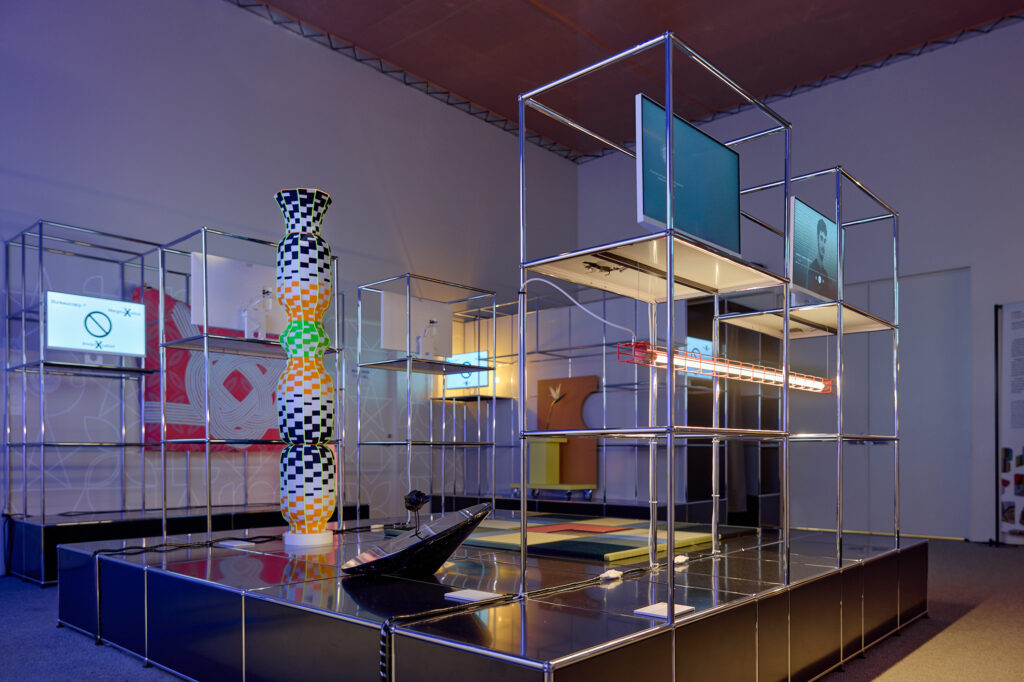
Rooted in the values of the New European Bauhaus and aligned with the UN 2030 Agenda and Expo’s central theme “Designing Future Society for Our Lives”, the exhibition will be complemented by a rich programme of talks, workshops and international exchanges. Together, they will turn every national pavilion into a space of ongoing dialogue about the role of design in transforming and improving our living environment.
Credits
Organised by the European Union
Curated by Patrizia Catalano and Miriam Giordano
Produced by Labóh and HoperAperta
With the support of the Baltic Pavilion and the Belgian Pavilion
Technical partners: USM Modular Furniture
Assistant to main curator: Federica De Giorgi
Exhibition Coordinators: Martina Barberis, Nicole Rambla
Video and sound installation: Steve Piccolo, Gregory Piccolo
Exhibition design: Antonio La Gioia
Graphic design: Valentina Pulian
Photography: Thomas Cude